PCCOE
Department of Computer Engineering
2025–26
The Evolution of AI
Discover the transformative journey from rigid rule-based systems to sophisticated generative models that understand, learn, and create.
● Presented by PCCOE Computer Department
The AI Evolution Timeline
From 1943 to 2025: Transformative breakthroughs that shaped modern AI
Artificial Neurons
McCulloch-Pitts neuron model introduced
Rule-Based Systems
Expert systems with explicit rules for AI applications
Backpropagation
Backpropagation algorithm revolutionized neural network training
Deep Learning
Deep neural networks transformed pattern recognition and machine learning
GANs Introduced
Generative Adversarial Networks enabled synthetic data creation
Transformers
Attention mechanisms revolutionized NLP and language models
Diffusion Models
DALL-E 2, Midjourney revolutionized AI image generation with diffusion-based models
Advanced AGI Era
Multimodal AI systems with advanced reasoning, real-time processing, and human-level problem solving
Watch as AI evolves through each era. Each milestone represents a breakthrough that shaped modern artificial intelligence.
Rule-Based Systems & Expert Systems
The genesis of artificial intelligence began with rule-based systems, also known as expert systems, which dominated AI research from the 1940s through the 1980s. These pioneering systems encoded human expertise into explicit "if-then" rules that computers could execute deterministically.
Architecture of Rule-Based Systems
Knowledge Base
Stores domain-specific expert rules and facts that govern system behavior.
Inference Engine
Applies rules to infer conclusions from input data systematically using logical deduction.
Working Memory
Holds dynamic facts being processed during system execution and reasoning.
User Interface
Interacts with humans for input and output of expert system results.
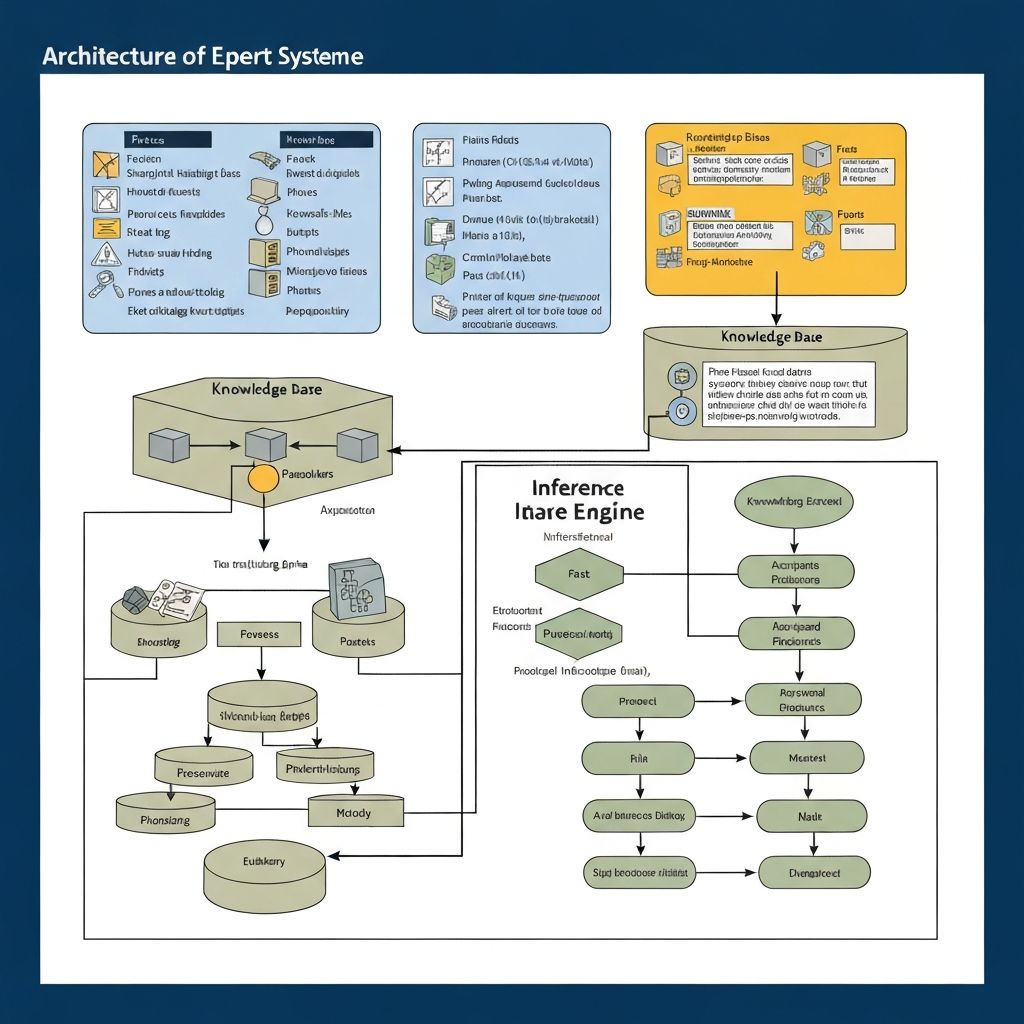
Architecture of Expert Systems
Core components showing knowledge representation, inference logic, and system interaction
Pioneering Examples & Milestones
1950s–60s
General Problem Solver (GPS)
Developed by Newell and Simon, GPS revolutionized AI by breaking problems into logical steps.
1965
DENDRAL
Pioneering molecular structure prediction system—enabled automated chemical analysis.
1970s
MYCIN
Medical expert system with ~600 rules diagnosing infections, matching expert doctor performance.
✓Strengths
- •Explainable reasoning - Users understand why decisions were made
- •Predictable behavior - Rule-driven logic ensures consistency
- •High accuracy - Performs exceptionally in narrow, well-defined domains
✗Limitations
- •Rigid structure - Fails completely outside defined rules
- •Poor scalability - Exponentially harder as rule complexity grows
- •No learning - Manual updates required for every new scenario
Why This Led to Machine Learning
The brittleness of rule-based systems became apparent by the 1980s. Complex domains required exponentially more rules, and any situation outside the rule set would cause complete failure. The community realized that instead of manually encoding every rule, systems needed to learn patterns from data. This fundamental shift sparked the move toward machine learning and neural networks in the 1990s.
The Shift to Machine Learning
The 1990s witnessed a paradigm shift from rigid rules to data-driven learning. Neural networks, with foundations laid in the mid-20th century, resurged with the rediscovery of backpropagation, enabling systems to learn patterns directly from data.
Neural Networks: The Building Blocks Timeline
1943
McCulloch-Pitts Model
Introduces the mathematical model of artificial neurons, foundational to all neural networks
1958
Rosenblatt's Perceptron
First neural network demonstrating pattern recognition, sparked significant interest in AI
1969
AI Winter Begins
Minsky & Papert's 'Perceptrons' book highlights limitations, research funding dries up for nearly a decade
1986
Backpropagation Revival
Rumelhart, Hinton & Williams rediscover backpropagation, enabling training of deep multilayer networks efficiently
1989
LeNet & Convolutional Networks
Yann LeCun applies CNNs to handwriting recognition—first practical deep learning success
Machine Learning Paradigms
Supervised Learning
Trains on labeled input-output pairs to learn mapping functions.
Unsupervised Learning
Finds patterns in unlabeled data, discovering hidden structures.
Reinforcement Learning
Learns by trial and error, optimizing for cumulative rewards.
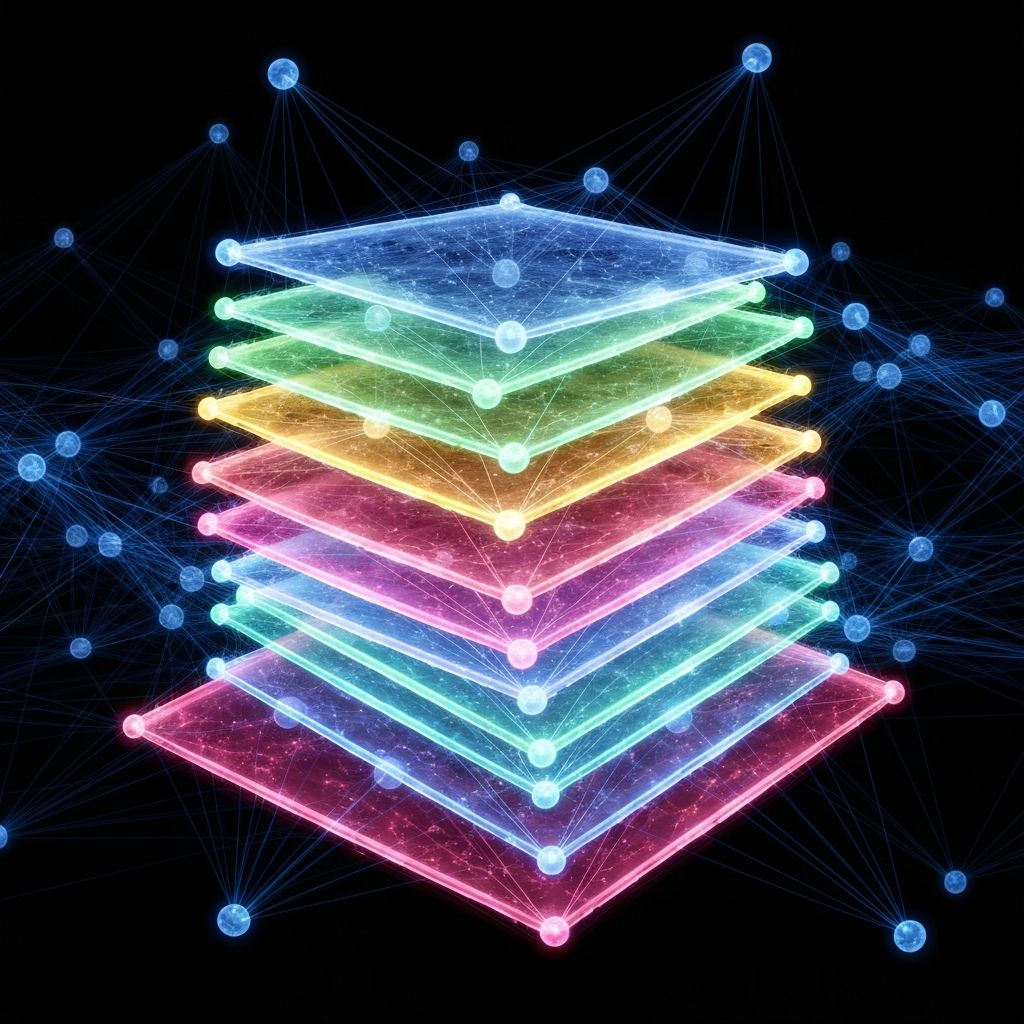
Neural Network Architecture
Interconnected nodes and layers enable learning from data patterns through backpropagation
Why This Led to Deep Learning
By the 2000s, computing power had increased exponentially, and datasets grew massive. Researchers discovered that deeper networks with more layers could learn increasingly abstract patterns. However, GPUs weren't widely used for training yet, making deep networks infeasible. Once GPU acceleration became available around 2006, deep learning would explode onto the scene.
The Deep Learning Revolution
The mid-2000s introduced deep learning, revolutionizing tasks like image and speech recognition through GPU acceleration and breakthrough architectures.
GPU Acceleration
Graphics processors drastically reduced training from months to weeks
100x faster
DanNet (2011)
Achieved superhuman image recognition capabilities
Superhuman accuracy
ImageNet 2012 - AlexNet
Won ImageNet challenge with unprecedented accuracy
85.2% accuracy
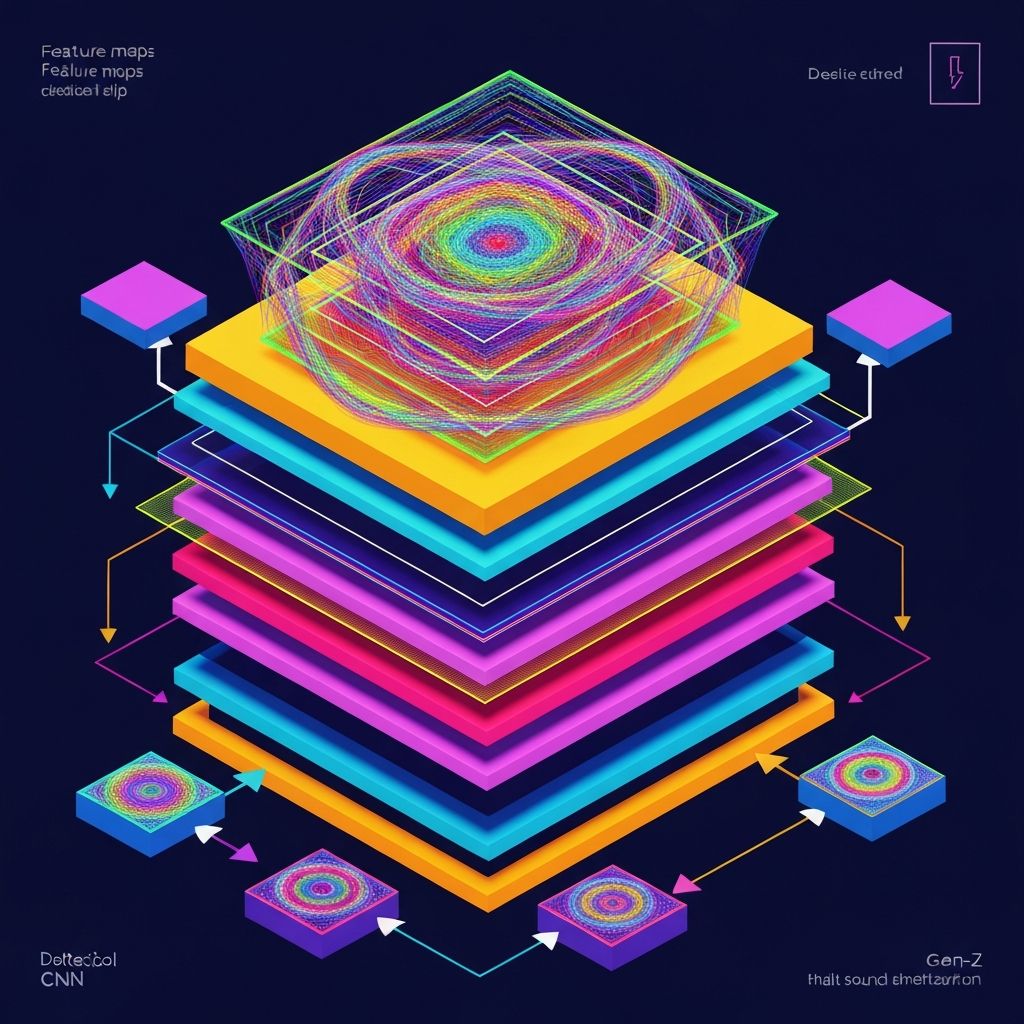
Convolutional Neural Networks
Hierarchical feature extraction from raw pixels to abstract patterns enables superhuman image recognition
2012 AlexNet Revolution
Key Developments in Deep Learning
GPU Acceleration
Dramatically accelerated training, enabling models to learn massive datasets in weeks
Deep Architectures
Enabled capture of complex hierarchical features from pixels to abstract concepts
Transfer Learning
Pre-trained models solve new problems faster with dramatically less data needed
Convolutional Layers
Became standard for vision tasks with pooling for efficiency and dimensionality reduction
The Age of Generative Models
Models that could generate diverse, realistic outputs fundamentally transformed creative and analytical AI capabilities.
Variational Autoencoders (VAEs)
VAEs introduced probabilistic latent spaces, enabling generation of diverse outputs from learned distributions. Became crucial for image generation, anomaly detection, and drug discovery.
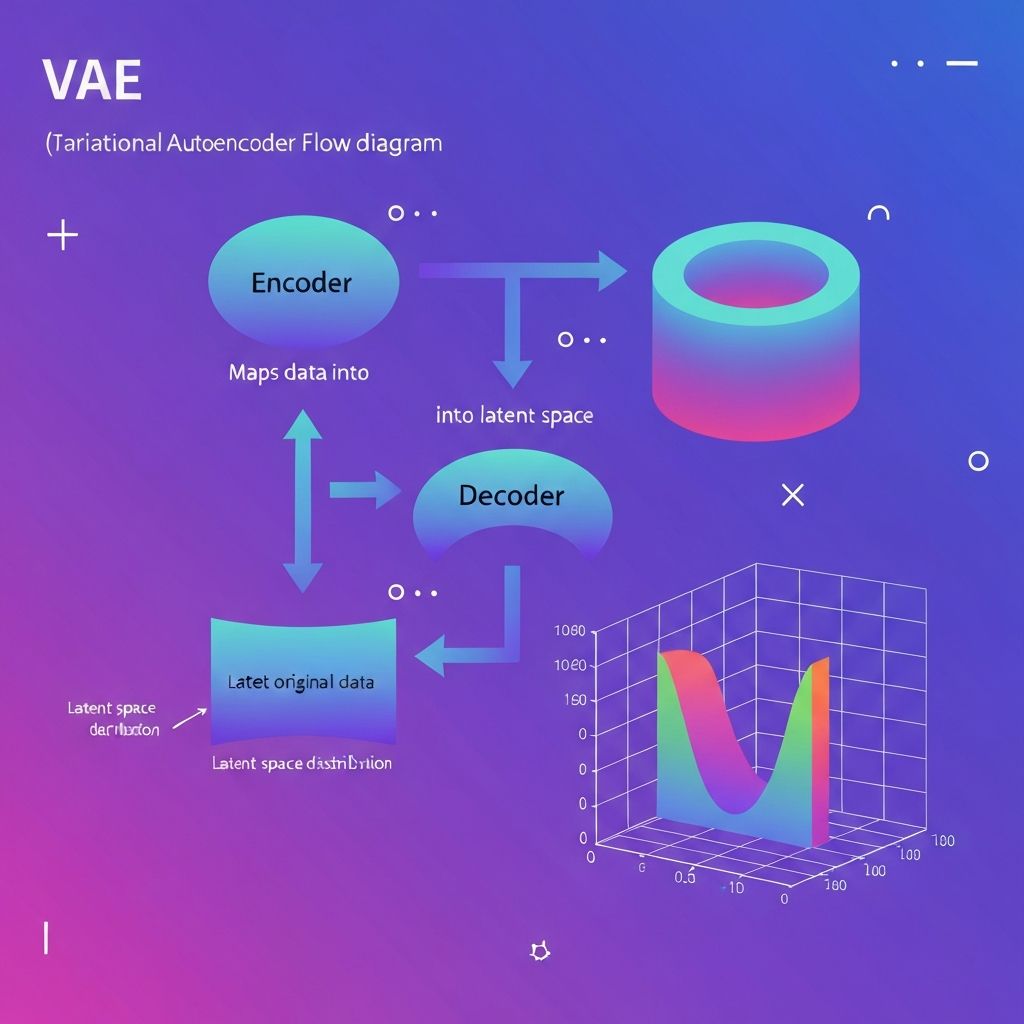
Probabilistic Generation Flow
Encodes to distribution, samples for diversity, decodes to generate novel outputs
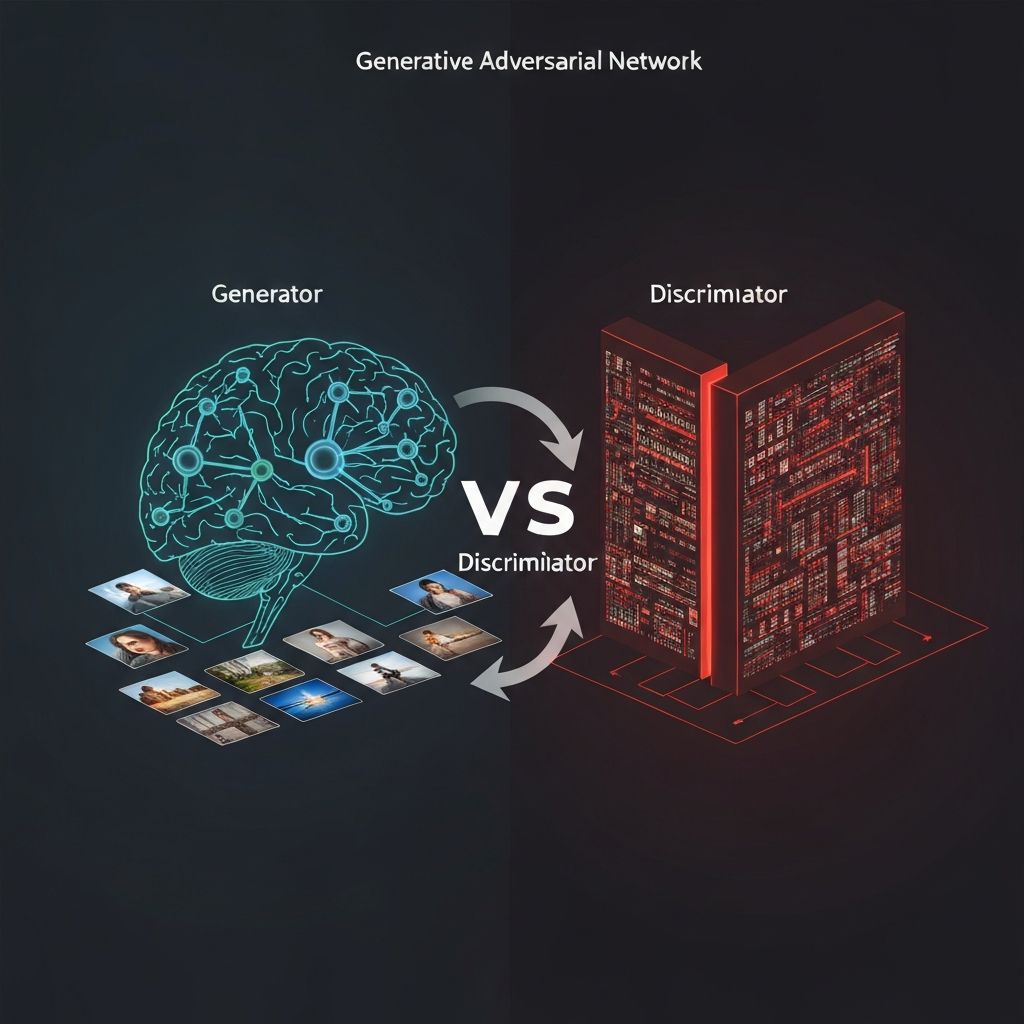
Generative Adversarial Network
Competitive learning between generator and discriminator produces photorealistic images
Generative Adversarial Networks (GANs)
Introduced in 2014 by Ian Goodfellow, GANs transformed generative AI through competitive dynamics between generator and discriminator, enabling highly realistic image synthesis.
Generator
Creates synthetic images attempting to fool the discriminator
Discriminator
Distinguishes real images from generated ones
Generative Model Comparison
🔹VAEs
⚔️GANs
Transformer Architecture Breakthrough
Transformers revolutionized AI by replacing recurrent architectures with attention mechanisms, enabling parallel processing of sequences and capturing long-range dependencies with unprecedented efficiency.
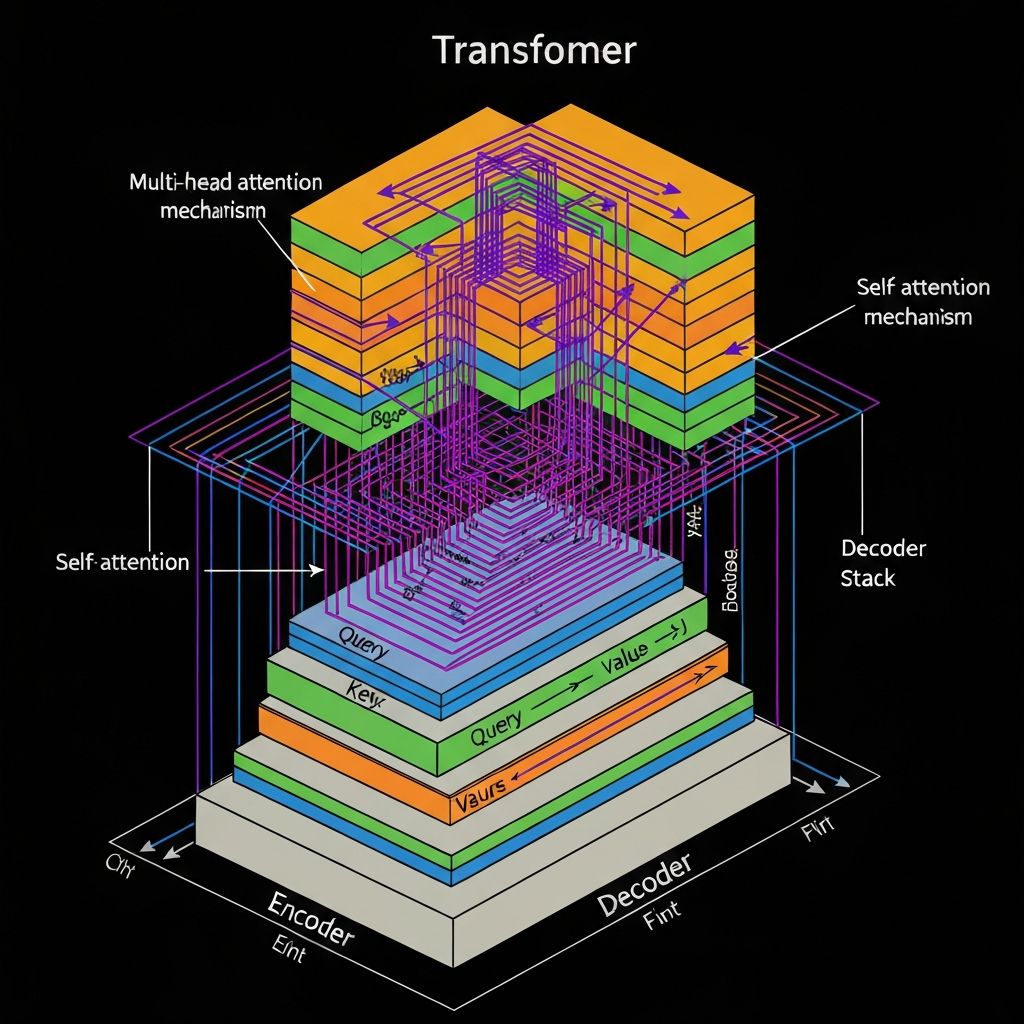
Transformer Architecture
Self-attention enables parallel processing and long-range dependency capture
Why Transformers Changed Everything
Transformers revolutionized AI by replacing recurrent architectures with attention mechanisms, enabling parallel processing of sequences and capturing long-range dependencies with unprecedented efficiency.
Attention Mechanism
Allows models to focus on relevant parts, understanding context and relationships better
Parallel Processing
Processes entire sequences simultaneously, dramatically increasing speed
Long-Range Dependencies
Captures relationships between distant tokens essential for language understanding
Transfer Learning
Pre-trained models fine-tune for diverse tasks with minimal additional data
Language Models: BERT & GPT Series
BERT (2018)
Introduced bidirectional context understanding, revolutionizing comprehension tasks
- •Bidirectional training
- •Superior language understanding
- •Pre-training framework
GPT Series (2018–2023)
Scaled parameters massively, achieving advanced generation. GPT-4 added vision capabilities
- •Large-scale generation
- •Few-shot learning
- •Multimodal reasoning (GPT-4)
Diffusion Models: The Latest Breakthrough
Emerging around 2015 and refined through the 2020s, diffusion models generate data by reversing a gradual noising process, overcoming GAN limitations with more stable training.
✓Advantages Over GANs
- •Stable training
- •Realistic outputs
- •Better convergence
- •Easier to debug
🎨Notable Models
- •DALL-E 2
- •Stable Diffusion
- •Midjourney
- •Modern generative AI foundation
Current Landscape & Future Outlook
AI has entered a transformative phase where generative systems achieve rapid global adoption, powering creative, analytical, and collaborative tasks at unprecedented scale.
The Current Landscape
Multimodal Intelligence
Models now process and understand text, images, audio, and video simultaneously.
Hybrid Techniques
Combining multiple approaches for more robust and capable systems.
Reasoning-Driven Behavior
Moving beyond pattern matching toward genuine understanding and reasoning.
Rapid Adoption
ChatGPT achieved 100M users faster than any previous application.
Persistent Challenges
High Compute Demands
Training modern models requires enormous computational resources, limiting accessibility and increasing environmental impact.
Bias & Fairness
Models can perpetuate societal biases present in training data, affecting fairness across demographics.
Interpretability Gaps
Understanding how and why models make decisions remains difficult—the persistent 'black box' problem.
Ethics & Safety
Concerns about AI misuse, misinformation, job displacement, and ensuring safe, beneficial AI deployment.
The Path Forward
Efficient Models
Creating capable models with lower computational costs, faster inference, and reduced environmental footprint.
Domain Specialization
Building tailored models optimized for specific industries—healthcare, finance, scientific research.
Human-AI Collaboration
Designing systems that augment rather than replace human capability, creating symbiotic partnerships.
Governance & Safety
Establishing frameworks for responsible AI deployment with transparency, accountability, and ethical guardrails.
The Evolution Continues
From rule-based logic to generative intelligence, AI has evolved from following instructions to learning and creating. This transformation represents more than technological progress—it marks a fundamental shift from automation to human augmentation.
As AI advances toward deeper understanding, enhanced reliability, and responsible deployment across industries, the most exciting chapter may still be ahead. The convergence of multiple technologies, improved efficiency, and ethical frameworks will define the next era of artificial intelligence.
"The future of AI lies not in creating machines that replace humanity, but in building tools that enhance human potential and solve humanity's greatest challenges."
Ready to dive deeper?
An exploration of artificial intelligence evolution by the Department of Computer Engineering, PCCOE • 2025–26